
The rich and eventful period of the My Peace project has steadily come to an end. It had everything: journeys, meetings, passionate discussions, and, of course, the music that accompanied the project throughout and made it so unique. As a result of more than two years of collaboration, many young people from various European countries, from Ireland to Ukraine, were able to get to know each other and express their views on how to build a peaceful community through creativity.
However, a fair question arises: what’s next?
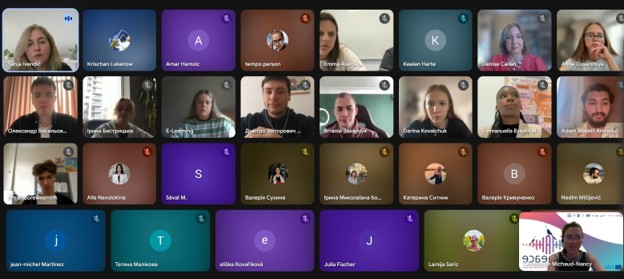
On May 26, 2026, the partners held their final meeting, during which the project team summarized their work and, most importantly, gave the floor to the young participants themselves. The meeting was not a formal closing of the project: rather, it became a space for a lively conversation about what remains after My Peace—in memories, in experiences, in new connections, and in the desire to continue.
Young people from different countries spoke about how My Peace helped them realize that music can truly become a language of dialogue. Even when participants didn’t always speak the same language fluently, they still found a way to communicate: through rhythm, voice, collective songwriting, shared stories, and simply through human presence. For many, this was the strongest proof that peacebuilding doesn’t begin with grand declarations, but with the ability to listen to one another.
They particularly vividly recalled the week-long workshop in Bordeaux. Participants fondly remembered meetings with organizations working to help refugees, exploring the city's history, attending master classes, and performing in front of an actual audience. For them, it was not only an artistic experience but also an opportunity to view the concept of peace through a different lens. One of the key conclusions expressed during the meeting was that peace is not merely an international or political issue. It is also a personal state of mind—the ability to understand oneself, listen to others, and find common ground, even when everyone’s life experiences differ.
Participants from Bosnia and Herzegovina, Ukraine, France, and other countries emphasized that the project created a rare opportunity to combine local experience with European exchange. Initially, the work took place in national groups through local music sessions, and then the young people were able to meet, compare their perspectives, share stories, and create something new together. For some, the most important aspect was a sense of inclusion and trust; for others, it was discovering new cultures and languages; for still others, it was realizing that creativity can help address complex topics without fear or tension.
Furthermore, one of the participants—Keelan from Ireland—already has several project ideas that he plans to launch this autumn or next summer. Here’s what he himself says about it:
« We are excited to go to Germany in September to reconnect with the German young people and tutors we met in Bordeaux. We are also working on a project in Sligo, where our University is located, using the lessons we learned from the MY PEACE project. We plan to collaborate with local schools and the local accommodation for asylum seekers, and allow children to play music together, to replicate some of the spirit of the project. »
In this sense, the question “what’s next?” received a very clear answer. The project is concluding its event phase, but its results will live on. Methodologies, reports, videos, and materials from the digital portal remain available on the My Peace website. Young participants and partners can continue to connect through the online community, social media, and the connections they’ve already made. Partners also highlighted that they’re ready to stay in touch with the young people if they come up with new ideas, initiatives, or a desire to develop similar projects.
My Peace demonstrated that music does not resolve conflicts on its own, but it can create a space where people begin to speak, listen, create, and trust. And for the young participants, this may well have been the most valuable outcome: they did not simply take part in the project, but gained the experience of how their voices, their stories, and their creativity can be part of a shared conversation about peace.